Exam questions for obtaining aircraft licenses and ratings
PPL(A) -
The air pressure that acts on anything immersed in it:-
If, on a given day, the actual outside air temperature at 4000 ft is 23°C, what is the approximate difference between the actual and ISA temperature?
The presence of water vapour:-
When considering the changes in density of the air with altitude, which of the following four options is correct?
The respective percentages of the four most abundant gases that make up the atmosphere are?
The properties of the Earth s atmosphere which influence the performance of aircraft are:
Assuming that the pressure at sea level is ISA, but the temperature is 10°C higher than ISA, the density will be:
A piston engine aircraft fiies in that layer of the atmosphere called:
In straight and level powered flight the following principal forces act on an aircraft:
The unit of force is the:
The dynamic pressure exerted on an aircraft's frontal surface is equal to:
Relative airflow is ___and_____the movement of the aircraft.
The symbol for dynamic pressure is:
The air flow over the wing's upper surface in straight and level flight, when compared with the airflow that is unaffected by the wing, will have:
Which of the four answer options most correctly completes the sentence? Increasing speed also increases lift because:
An aircraft has a nose down pitching moment due to the lift/weight couple and a nose up pitching moment due to the thrust/drag couple. When power is increased:
Considering the forces acting upon an aeroplane, at constant airspeed, which statement is correct?
In straight and level flight, the free stream airflow pressure, compared to that flowing under the wing, is:
If the cross sectional area of an airflow is mechanically reduced:
When considering air:
1 - Air has mass
2 - Air is not compressible
3 - Air is able to flow or change its shape when subject to even small pressures
4 - The viscosity of air is very high
5 - Moving air has kinetic energy
The correct combination of all true statements is:
An aircraft rotates about:
An aircraft's mass is a resuit of:
If the velocity of an air mass is increased:
The boundary layer consists of:
What must be the relationship between the forces acting on an aircraft in flight, for that aircraft tobe in a state of equilibrium?
The smooth flow of air, where each molecule follows the path of the preceding molecule, is a definition of:
In sub-sonic airflow, as air passes through a venturi, the mass flow_____, the velocity _____and the static pressure_____.
A moving mass of air possesses kinetic energy. An object placed in the path of such a moving mass of air will be subject to:
Dynamic Pressure may be expressed by the formula:
As airspeed increases, induced drag:
As Indicated Air Speed (IAS) is reduced, in order to maintain altitude, the pilot must:
That portion of the aircraft's total drag created by the production of lift is called:
By changing the Angle of Attack of a wing, the pilot can control the aeroplane's:
Resistance, or skin friction, due to the viscosity of the air as it passes along the surface of a wing, is a type of:
If the Indicated Air Speed of an aircraft is increased from 50 kts to 100 kts, parasite drag will be:
An imaginary straight line running from the midpoint of the leading edge of an aerofoil to its trailing edge, is called the:
A positively cambered aerofoil starts to produce lift at an angle of attack of approximately:
On an aerofoil section, the force of lift acts perpendicular to, and the force of drag acts parallel to, the:
As airspeed increases induced drag_____, parasite drag_____and total drag
If in level flight the airspeed decreases below that for maximum Lift/Drag, the effect will be that:
The angle of attack is the angle between the:
The maximum value of the coefficient of lift is found at an angle of attack of approximately:
At a constant angle of attack, a decrease in the airspeed of an aircraft will result in:
If the Angle of Attack and other factors remain constant, and the airspeed is doubled, lift will be:
The definition of lift is:
Which of the answer options most correctly completes the sentence? The amount of lift a wing produces is directly proportional to:-
The maximum value of the Coefficient of Lift is found:
At a given Indicated Air Speed, what effect will an increase in air density have on lift and drag?
An aerofoil section is designed to produce lift resulting from a difference in the:
Full flaps should be selected when:
A wing which is inclined downwards from root to tip is said to have:
When the C of G is close to the forward limit:
Following a lateral disturbance, an aircraft with Dutch roll instability will:
An aeroplane which is inherently stable will:
After a disturbance in pitch, an aircraft oscillates in pitch with increasing amplitude. It is:
If a disturbing force causes an aircraft to roll:
If the wing Aerodynamic Centre is forward of the C of G:
By design, the Centre of Pressure on a particular aircraft remains behind the aircraft's C of G. If the aircraft is longitudinally stable and is displaced in pitch, nose down, by turbulence:
Wing dihedral produces a stabilising rolling moment by causing an increase in lift:
When an aircraft is disturbed from its established flight path by, for example, turbulence, it is saidto have positive stability if it subsequently:
Loading an aircraft so that the C of G exceeds the aft limits could result in:
Which of the following four options describes the consequence of taking off with the manufacturer's recommended take-off flap setting selected?
With the flaps lowered, the stalling speed will:
When an aircraft is disturbed from its trimmed attitude by, for example, turbulence, it is said to have neutral stability if it subsequently:
If the Centre of Gravity (C of G) of an aircraft is found to be within limits for take-off:
With a forward Centre of Gravity, an aircraft will have:
Longitudinal stability is given
An aft Centre of Gravity will give:
The tendency of an aircraft to develop forces which restore it to its original flight situation, when disturbed from a condition of steady flight, is known as:
Stability around the normal axis:
The maximum gliding distance from 6000 feet, for an aircraft in clean configuration, with a lift/drag ratio of 8:1, is approximately 8 nautical miles. If flaps are deployed:
A pilot lowers the flaps while keeping the airspeed constant. In order to maintain level flight, the angle of attack:
Movement of the aircraft about its normal (vertical) axis is known as:-
An aircraft wing is constructed with positive dihedral in order to give:
An aircraft is disturbed from its path by a gust of wind. Neutral stability is when, without pilot intervention, it:
When flaps are lowered the stalling angle of attack of the wing:
A high wing configuration with no dihedral, compared to a low wing configuration with no dihedral, will provide:
An aircraft is disturbed from its flight path by a gust of wind. If it tends to return to its original flight path without pilot intervention, the aircraft is said to possess:
Wing leading-edge devices such as slots, designed to allow flight at higher angles of attack, do so by:
The surface that gives an aircraft directional stability is:
If a landing is to be made without flaps the landing speed must be:
The maximum speed at which the aircraft can be flown with flaps extended is called:
Yawing is movement around the_____axis.
The lateral axis of an aircraft is a line which:
Lowering the fiaps during a landing approach:
During a manoeuvre, the ailerons are deflected and returned to neutral when the aircraft has attained a small angle of bank. If the aircraft then returns to a wings-level attitude without furthercontrol movement, it is:
The purpose of an anti-balance tab is to:
The phenomenon of flutter is described as:
An aileron could be balanced aerodynamical I y by:
When the control column is pushed forward, a balance tab on the elevator:
The purpose of a differential ailerons is to:
The respective primary and secondary effects of the rudder control are:
On an aircraft with a simple trim tab incorporated into a control surface, when the surface is moved, the tab remains in the same position relative to the:
Which flying control surface(s) give(s) control about the aircraft's normal axis?
The primary and secondary effects of applying the left rudder alone are:
When displacing the ailerons from the neutral position:
An aircraft's rudder is fitted with a balance tab. Movement of the rudder bar to the right, to yaw the aircraft to the right, will move the balance tab to the:
An aircraft has a tendency to fly right wing low with hands off. It is trimmed with a tab the left aileron. The trim tab will:
Following re-trimming for straight and level flight, in an aircraft with a C of G near its forward limit, and an elevator fitted with a conventional trim-tab:
Controls are mass balanced in order to:
The primary and secondary effects of the aileron control are:
The purpose of a spring-bias trim system is:
A control surface may have a mass balance fitted to it, in order to:
A control surface may be mass balanced by:
Fixed trim tabs on ailerons:
Which flying control surface(s) give(s) longitudinal control?
The purpose of a trim tab is:
Yawing is a rotation about:
If the control column is moved forward and to the left:
If the control column is moved to the right, a balance tab on the left aileron should:
'Differential Ailerons'are a design feature that helps to counteract:
If the angle of attack is increased above the stalling angle:
If the Angle of Attack is increased beyond the Critical Angle of Attack, the wing will no longer produce sufficient lift to support the weight of the aircraft:
An aeroplane wing stalls when:
The stalling speed of an aircraft in straight and level flight is 60 kt, IAS. What is its stalling speed in a level 60° banked turn?
When an aircraft is in a steady climb, the aerodynamic lift is_____the weight.
A typical stalling angle of attack for an aircraft wing is:
The maximum angle of climb of an aeroplane is determined by:
The angle of attack at which an aeroplane stalls:
When the aircraft is in a spin, the direction of spin is most reliably found by reference to which of the following indications?
The reason for washout being designed into an aircraft wing is to:-
The maximum allowable airspeed with flaps extended (VFE) islower than cruising speed because:
The basic staiiing speed of an aeroplane is 80 knots. In a level turn with 45° angle bank, the stalling speed is:
At the stall, the Centre of Pressure moving backwards will cause the nose to_____, and the decreased lift will cause the aircraft to_____.
In a climb at a steady speed, the thrust is:
What is the significance of the speed known as VNO?
The stalling speed of an aircraft, assuming weight to be constant, is a function of the:
The angle of climb is proportional to:
If an aircraft is flown at its design manoeuvring speed VA:
If the aircraft weight is increased, without change of C of G position, the stalling angle attack will:
At which angle of attack should we normally expect beginning of a stall?
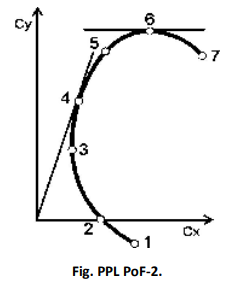
The best angle of attack on the wing polar diagram is marked as: (See Fig. PPL PoF-2)
The critical angle of attack on the wing polar diagram is marked as: (See Fig. PPL PoF-2)
The angle of attack for a minimum drag on the wing polar diagram is marked as: (See Fig. PPL PoF-2)
Which wing shape has the greatest induction drag?
If the velocity of an airstream is doubled the drag coefficient will
Approximately for what percent will the stall speed increase if wing loading increases by 15%?
What is the approximate percentage increase of a minimum speed if an aircraft mass is increased for 20%?
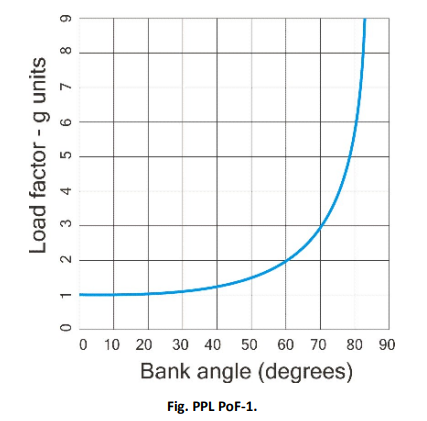
If an airplane weights 3,000 pounds, what approximate weight would the airplane structure be required to support during a 20° banked turn while maintaining altitude? (See Fig. PPL PoF-1)
If an airplane weights 4,600 pounds, what approximate weight would the airplane structure be required to support during a 50° banked turn while maintaining altitude? (See Fig. PPL PoF-1)
What is the maximum allowed bank angle when flying an aircraft with limiting load factor of +2,5 G? (See Fig. PPL PoF-1)
What is the maximum allowed bank angle when flying an aircraft with limiting load factor of +3,8 G? (See Fig. PPL PoF-1)
What is the load factor in a 60° banked level turn? (See Fig. PPL PoF-1)
The airspeed at which a pilot will not yet overstress the airframe of an aicraft by momentarily up-deflecting the elevator is