Exam questions for obtaining aircraft licenses and ratings

PPL(A) -

  1. Maximum Landing Mass (MLM) is best defined as.

    • What V speed is it important not to exceed if sudden full-pitch, nose-up, control movements are planned, and why?

      • What is the colour of the caution speed range on an Air Speed Indicator, and what must the pilot be mindful of when operating in this range?

        • What name is given to the load at which the aircraft structure will fail?

          • An aircraft which has been grossly overloaded will: 1.require increased take-off and landing distances. 2. Have a higher stalling speed. 3. Have a reduced maximum level flight speed. 4. Have increased range and endurance. 5. Have a reduced rate of climb and operating ceiling. Which of the above are correct?

            • Maximum Zero Fuel Mass (MZFM) is best defined as.

              • Maximum Take Of Mass (MTOM) is defined best as:

                • Which of the following situations may, under certain conditions, result in structural damage occurring?

                  • Never exceed speed (VNE) is the red radial line on the ASI and marks the speed at which:

                    • When flying in very rough air what is the maximum speed to be adopted in order to avoid overstressing the airframe?

                      • Your aircraft has an oil reservoir with a capacity of 3 imp/gal which is positioned 20 inches aft of the datum. Given that the oil weighs 9.1 lbs/gal, the reservoir will possess a moment of:-

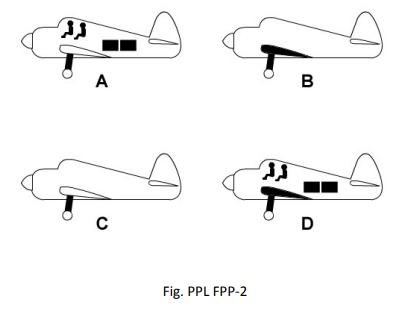
                        • Assuming the aircraft is at rest on the ground, what term best describes image 'D'? (See fig. PPL FPP-2)

                          • An aircraft is loaded such that its C of G is on the aft limit:- I The stalling speed decreases, which is a negative factor. II Range and endurance decrease, which are negative factors. III The stall risk increases, which is a negative factor. IV Stick forces increase, which is a negative factor.

                            • Certification requirements stipulate that when loading a light aircraft:

                              • The Maximum Take-off Mass of an aircraft may be limited by:-

                                • DOM (Dry Operating Mass) is defined as:

                                  • An aircraft loaded in a dangerous manner, so that its C of G is beyond its forward limit will:

                                    • The flight characteristics of an aircraft which has its C of G at the forward limit will be:-

                                      • An aircraft weighing 2000 lbs with a total CofG moment of + 169400 lb in uplifts 440 lbs of fuel. If the effective arm of the fuel is 88.5 inches aft of the datum, what will be the aircraft's new mass and C of G moment?

                                        • You plan to carry your aircraft's maximum permissible 'Traffic Load'. Your principal consideration during your flight planning will be that:-

                                          • Traffic Load':-

                                            • The consequences of operating an aeroplane with the C of G beyond the aft limit will be:- I On the ground the aircraft would be tail heavy and passenger or crew movement or fuel usage could make it tip up. II The flying controls would be too sensitive increasing the risk of a tail strike at rotation. III The tendency to stall would increase and it may be impossible to achieve 'hands off' balanced flight. IV Recovery from a spin would be much more difficult.

                                              • Assuming the aircraft is at rest on the ground, what term best describes image A'? (See fig. PPL FPP-2)

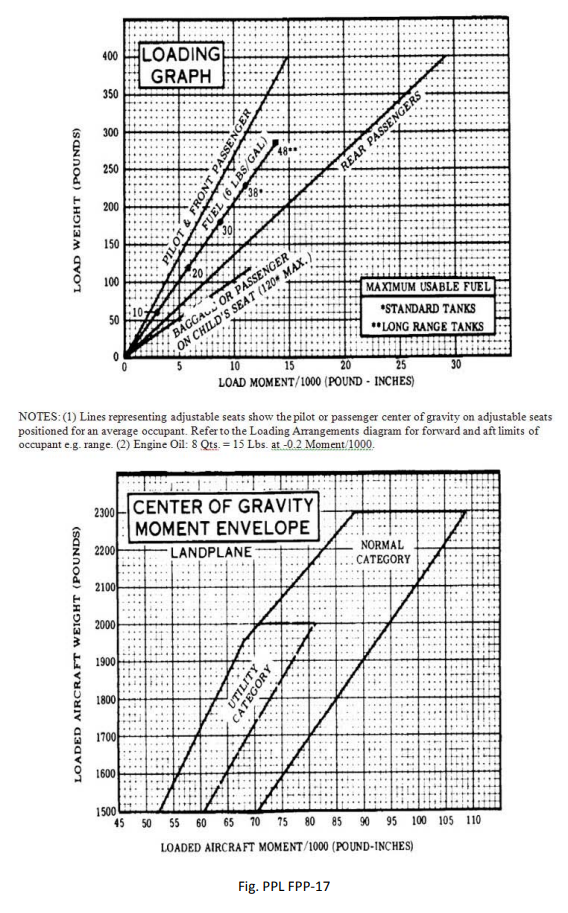
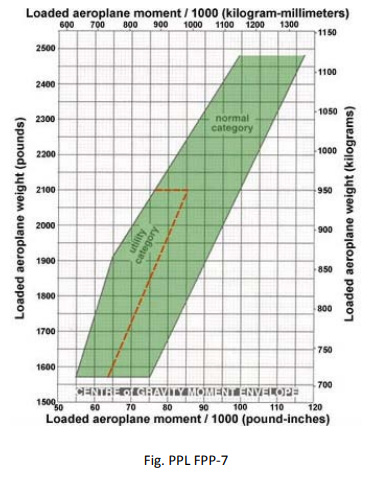
                                                • In which Category. Utility or Normal, would you expect to operate the aircraft represented in the attached CofG /Moment Envelope if its mass is 2100 lbs and its CofG Moment 90,000 lb inches? (See fig. PPL FPP-7)

                                                  • What is used as the aircraft reference for the C of G limit, and upon which axis is that limit found?

                                                    • C of G limits are set by the manufacturer and:

                                                      • Your aircraft has:- A Take-off Mass of = 2353 tbs A calculated C of G for departure = 89.75 inches aft of the datum An estimated fuel burn = 200 lbs with a C of G 85.00 inches aft of datum. The position of the C of G on landing will be?

                                                        • The Centre of Gravity range of most aircraft reduces as the aircraft mass increases, as a result of:-

                                                          • When calculating the MZFM (maximum zero fuel mass), the following are included:-

                                                            • What effect will a higher aircraft mass have on rotate speed and take-off safety speed?

                                                              • What is the effect of runway slope on the take-off?

                                                                • That part of a runway surface which is used for normal operations during take-off, excluding any clearway or stopway, is referred to as:-

                                                                  • If the density of the atmosphere is reduced, the take-off distance will be:-

                                                                    • If the density of the air is increased above ISA conditions, the effect will be:-

                                                                      • When the density of the atmosphere is relatively low, the resulting reduction in:-

                                                                        • The main reason for taking off into wind is to:-

                                                                          • Increasing the aeroplane's gross weight will have what effect on the take-off?

                                                                            • What is the reason for increasing the speed in a prolonged climb:-

                                                                              • Climbing at Vy will achieve:-

                                                                                • To gain the greatest amount of height in the shortest time period the aircraft should be flown at:-

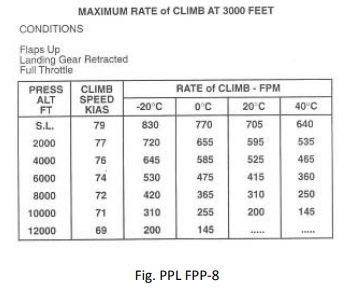
                                                                                  • Calculate the rate of climb for an aircraft operating at 5000ft with an outside air temperature of 0°C

                                                                                    • Increasing the mass (and, therefore, weight) of the aircraft will:-

                                                                                      • The best rate of climb is achieved:-

                                                                                        • The indicated air speed for the best rate of climb when climbing to cruise altitude will tend to:-

                                                                                          • The lift produced by the wing of an aeroplane that is climbing and maintaining a constant airspeed will be:-

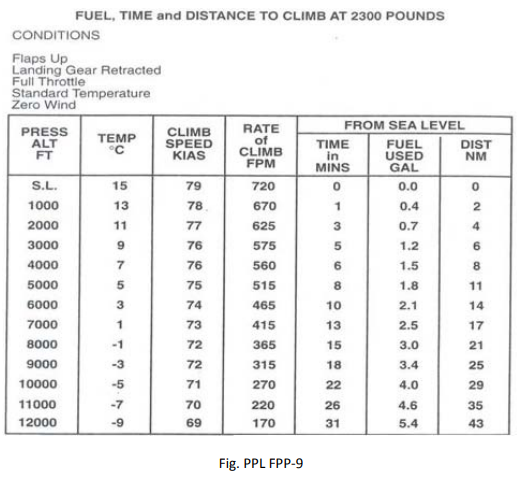
                                                                                            • An aircraft cruising at 2000ft is cleared to climb to 8000ft. Calculate the time taken in minutes, the fuel used in gallons and the distance flown during the climb. The temperature is standard and the wind is calm. Time (mins) Fuel (gal) Distance (nm)

                                                                                              • Climbing at Vx will achieve:-

                                                                                                • If the centre of gravity is moved aftwards. The effect is?

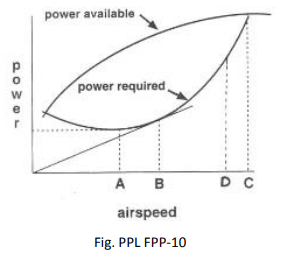
                                                                                                  • What speed should be flown for maximum range: (See fig. PPL FPP-10e)

                                                                                                    • What is the maximum range speed for a piston engine aircraft?

                                                                                                      • In order to maximise the glide range, the aircraft should be flown:

                                                                                                        • A pilot wishes to fly at a speed which will give him maximum range. He knows that he is flying with a tailwind. How will the speed selected by the pilot compare with the maximum range speed for still air?

                                                                                                          • Which of the following cases will result in a reduced performance and possibly exceed the structural limitations of the aircraft?

                                                                                                            • What is the effect of a headwind on the glide angle and glide distance?

                                                                                                              • What speed must be flown to attain the maximum cruise endurance?

                                                                                                                • The maximum glide range will be achieved by:-

                                                                                                                  • If weight is increased, the range of the aircraft will be:

                                                                                                                    • A wing contaminated by a small amount of ice will produce:-

                                                                                                                      • When gliding for maximum range, an aircraft with a greater weight will:-

                                                                                                                        • What speed must be flown to attain the maximum cruise range?

                                                                                                                          • What would be the effect of an increase in temperature upon the air density and aircraft performance?

                                                                                                                            • Compared to gliding in still air, the effect of a tailwind will:-

                                                                                                                              • Which of the speeds indicated by A, B, C or D should be flown for maximum endurance? (See fig. PPL FPP-10e)

                                                                                                                                • During straight and level flight, any increase in lift causing an imbalance in the equilibrium of forces is compensated for by:

                                                                                                                                  • What is the effect of an increase in mass on the staii speed and landing distance required?

                                                                                                                                    • When landing, if an aircraft's true air speed is significantly less than the true ground speed then the aircraft is experiencing:

                                                                                                                                      • If the approach and landing speed is higher recommended speed in the aircraft manual the effect will be that:

                                                                                                                                        • What effect would a 2% downslope have on the landing distance required?

                                                                                                                                          • Compared to landing on a level runway, what would be the effect of landing on a downward sloping runway?

                                                                                                                                            • If the stalling speed in the landing configuration is 55 knots. VREFwould be approximately:

                                                                                                                                              • The VREFto be attained by the landing screen height of 50ft must be:

                                                                                                                                                • If the aircraft mass is increased by 15%, the landing distance required will increase approximately:

                                                                                                                                                  • Landings are carried out into wind because:

                                                                                                                                                    • Determine if the aircraft mass is inside the limits (normal category)! (See fig. PPL FPP-17e) item mass (lb) moment/1000 (lbxin) Empty mass 1,350 51.5 Pilot and front passenger 360 Rear passengers 280 Fuel 30 US gal. Oil, 8 qt -0.2

                                                                                                                                                      • What is the maximum amount of fuel that may be aboard the airplane on takeoff if loaded as follows? (See fig. PPL FPP-17e) item mass(lb) moment/1000 (lbxin) Empty mass 1,350 51.5 Pilot and front passenger 340 Rear passengers 310 Baggage 45 Oil, 8 qt -0.2

                                                                                                                                                        • GIVEN: item mass(lb) arm(in) moment (lbxin) Empty mass 1,495.0 101.4 151,593.0 Pilot and passenger 380.0 64.0 Fuel 30 US gal 96.0 The CG is located how far aft of datum?

                                                                                                                                                          • Determine the moment with the following data: (See fig. PPL FPP-17e) item mass (lb) moment/1000 (lbxin) Empty mass 1,350 51.5 Pilot and front passenger 340 Fuel (full std. tanks) Oil, 8 qt -0.2

                                                                                                                                                            • What is the maximum amount of baggage that may be loaded aboard the normal category airplane for CG to remain inside proper limits? (See fig. PPL FPP-17e) item mass (lb) moment/1000 (lbxin) Empty mass 1,350 51.5 Pilot and front passenger 250 Rear passengers 400 Fuel 30 US gal. Baggage Oil, 8 qt -0.2

                                                                                                                                                              • The easiest way to determine the pressure altitude is setting an altimeter to

                                                                                                                                                                • Basic reason for calculating the density altitude is determining

                                                                                                                                                                  • What is pressure altitude?

                                                                                                                                                                    • Under which condition will pressure altitude be equal to true altitude?

                                                                                                                                                                      • Which of the factors below increases the density altitude of an airport?

                                                                                                                                                                        • Under what condition is indicated altitude the same as true altitude?

                                                                                                                                                                          • If the outside air temperature (OAT) at a given altitude is lower than standard, the density altitude is

                                                                                                                                                                            • What is density altitude?

                                                                                                                                                                              • Determine approximately density altitude of an airport, where the temperature is standard and an altimeter set to 1011hPa, reads 1,300 ft.

                                                                                                                                                                                • What is increase in density altitude if a temperature increases from 0 to 10°C and if the pressure altitude of an airport remains 3,000 ft?

                                                                                                                                                                                  • Determine the pressure altitude with an indicated altitude 1,380 ft with an altimeter setting of 1013.2 hPa at standard temperature.

                                                                                                                                                                                    • What is the effect of a temperature increase of 12°C on the density altitude?

                                                                                                                                                                                      • Determine the density altitude of an airport for these conditions: QNH 1025 hPa temperatura -4°C elevation 3,850 ft

                                                                                                                                                                                        • What is the approximate pressure altitude if an altimeter is set to 1010 hPa and indicates 1,380 ft?

                                                                                                                                                                                          • Determine the density altitude of an airport for these conditions: QNH 1010 hPa temperature 27°C elevation 5,250 ft

                                                                                                                                                                                            • The density altitude could be approximately calculated from the pressure altitude without using a navigation calculator by

                                                                                                                                                                                              • Which of the statements below, concerning take-off performance of a powered aircraft regarding the density altitude is correct? At higher density altitudes

                                                                                                                                                                                                • How does higher air humidity affect aircraft take-off performance? Take-off distances are

                                                                                                                                                                                                  • Which combination of atmospheric conditions will reduce aircraft takeoff and climb performance?

                                                                                                                                                                                                    • What influence does the increased mass have on powered aircraft takeoff performance?

                                                                                                                                                                                                      • What effect does an uphill runway slope have on takeoff performance?

                                                                                                                                                                                                        • What effect does high density altitude have on aircraft performance?

                                                                                                                                                                                                          • The airplane's or powered hang glider's best angle-of-climb speed (Vx) is used

                                                                                                                                                                                                            • Which speed would provide the greatest gain in altitude in the shortest distance during climb after takeoff?

                                                                                                                                                                                                              • The aircraft's rate-of-climb during a steady climb depends on

                                                                                                                                                                                                                • After takeoff, which airspeed would the pilot use to gain the most altitude in a given period of time?

                                                                                                                                                                                                                  • What is the proper use for the best-rate-of-climb speed (Vy)?

                                                                                                                                                                                                                    • What is the influence of the wind on an aeroplane's rate of climb?

                                                                                                                                                                                                                      • What influence does the wind have on an airplane's angle-of-climb?

                                                                                                                                                                                                                        • The aircraft's climb angle during a steady climb depends on

                                                                                                                                                                                                                          • At takeoff from a short airfield with an airplane or a powered hang glider, which airspeed should you fly until cleared of obstacles?

                                                                                                                                                                                                                            • During landing on an airport with high elevation the true air speed (TAS) of an aircraft is higher than normal. What indicated speed (IAS) should be kept in such cases?

                                                                                                                                                                                                                              • Should you use the normal approach speed when approaching to land in gusty wind conditions?

                                                                                                                                                                                                                                • Maximum structural cruising speed is the maximum speed at which an airplane can be operated

                                                                                                                                                                                                                                  • Why should speeds in flight above VNE be avoided?

                                                                                                                                                                                                                                    • Which maximum range factors decreases as weight decreases?

                                                                                                                                                                                                                                      • Which V-speed represents maneuvering speed?

                                                                                                                                                                                                                                        • Maneuvering speed (VA) is the highest speed at which even full abrupt deflection of the elevator will not exceed

                                                                                                                                                                                                                                          • How will higher altitude affect the cruising indicated airspeed of an aircraft if a throttle remains unchanged?

                                                                                                                                                                                                                                            • What does 'Best Endurance Speed' for a propeller aircraft mean?

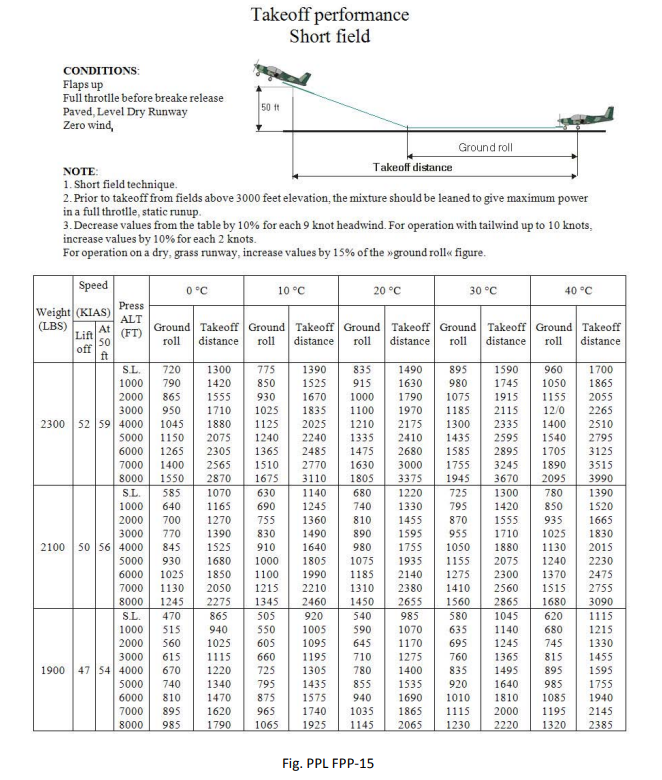
                                                                                                                                                                                                                                              • Determine the takeoff distance over a 50-foot obstacle under the following conditions: (See fig. PPL FPP-15e) pressure altitude 0 ft temperature standard mass 1900 lb wind calm surface grass, dry

                                                                                                                                                                                                                                                • Determine the ground roll distance required for takeoff! (See fig. PPL FPP-15e) pressure altitude 2,000 ft temperature 40°C mass 2100 lb wind tail 4 kt surface tarmac

                                                                                                                                                                                                                                                  • Determine the takeoff distance over a 50-foot obstacle under the following conditions: (See fig. PPL FPP-15e) pressure altitude 4,000 ft temperature 15°C mass 2300 lb wind calm surface asphalt

                                                                                                                                                                                                                                                    • Determine the takeoff distance over a 50-foot obstacle under the following conditions: (See fig. PPL FPP-15e) pressure altitude 2,000 ft temperature 30°C mass 2100 lb wind head 18 kt surface grass, dry

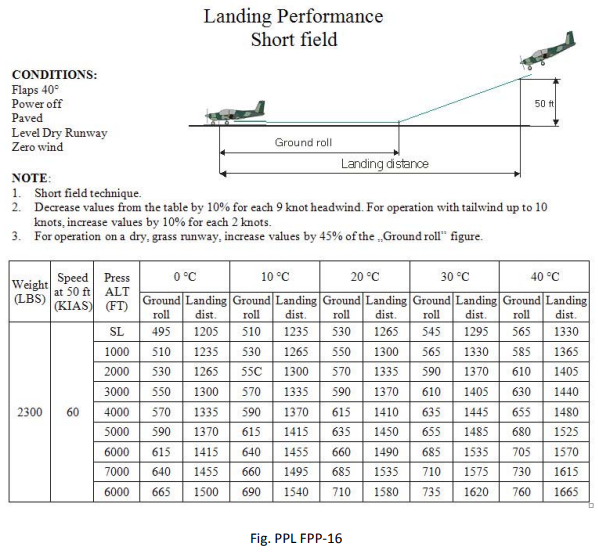
                                                                                                                                                                                                                                                      • Determine the total distance required to land. (See fig. PPL FPP-16e) pressure altitude 1,000 ft temperature 30°C mass 2300 lb wind head 9 kt surface tarmac

                                                                                                                                                                                                                                                        • Determine the ground roll distance after landing. (See fig. PPL FPP-16e) pressure altitude 0 ft temperature 10°C mass 2300 lb wind head 10 kt surface grass, dry

                                                                                                                                                                                                                                                          • Determine the ground roll distance after landing. (See fig. PPL FPP-16e) pressure altitude 0 ft temperature 15°C mass 2300 lb wind calm surface tarmac

                                                                                                                                                                                                                                                            • Determine the ground roll distance after landing. (See fig. PPL FPP-16e) pressure altitude 3,000 ft temperature 20°C mass 2200 lb wind calm surface grass, dry

                                                                                                                                                                                                                                                              • Determine the total distance over a 50-foot obstacle required to land. (See fig. PPL FPP-16e) pressure altitude 1,000 ft temperature 10°C mass 2300 lb wind tail 10 kt surface tarmac

                                                                                                                                                                                                                                                                • Determine the total distance over a 50-foot obstacle required to land. (See fig. PPL FPP-16e) pressure altitude 1,500 ft temperature 30°C mass 2300 lb wind calm surface tarmac

                                                                                                                                                                                                                                                                  • Determine the total distance over a 50-foot obstacle required to land. (See fig. PPL FPP-16e) pressure altitude 0 ft temperature 0°C mass 2300 lb wind head 18 kt surface grass, dry

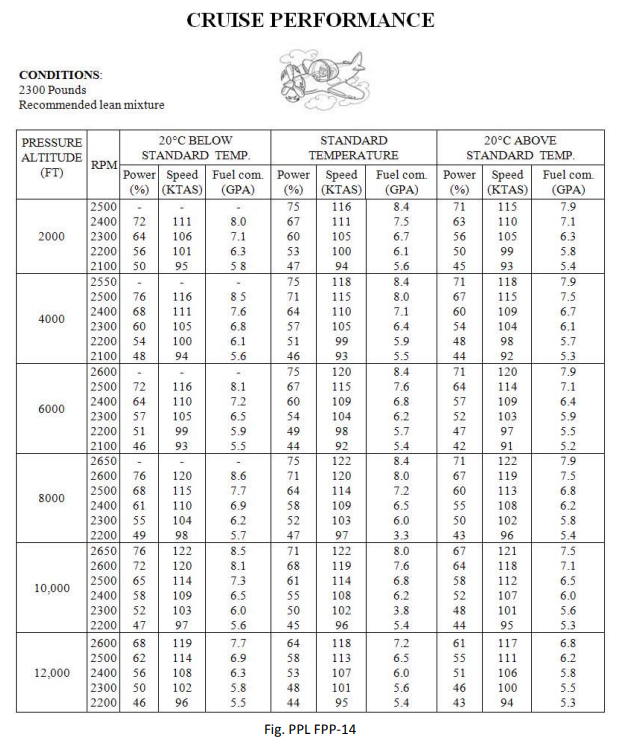
                                                                                                                                                                                                                                                                    • What will be the airspeed of an airplane in level flight under the following conditions? (See fig. PPL FPP-14e) pressure altitude 8,000 ft temperature 20°C below standard power setting 55%

                                                                                                                                                                                                                                                                      • What is the expected fuel consumption for a 250-nautical flight under the following conditions? pressure altitude 6,000 ft temperature 20°C above standard power setting 60% wind calm

                                                                                                                                                                                                                                                                        • What is the expected fuel consumption for a 350-nautical flight under the following conditions? pressure altitude 4,000 ft temperature 20°C below standard power setting 60% wind calm

                                                                                                                                                                                                                                                                          • Approximately what engine RPM should be set during cruising at the pressure altitude 2,000 ft and with standard temperature in order to develop 60% of power? (See fig. PPL FPP-14e)

                                                                                                                                                                                                                                                                            • What is the expected fuel consumption under the following conditions? (See fig. PPL FPP-14e) pressure altitude 8,000 ft temperature 20°C below standard power setting 55%

                                                                                                                                                                                                                                                                              • Which forward speed is normally maintained, following an engine failure in flight in a light airplane?

                                                                                                                                                                                                                                                                                • The forward speed for minimum rate of descent of an aircraft, compared with its best glide speed, is

                                                                                                                                                                                                                                                                                  • What should be done first, following an aircraft's engine failure in flight?

                                                                                                                                                                                                                                                                                    • An aircraft without an engine will fly the longest distance from a given altitude at the angle of attack at which

                                                                                                                                                                                                                                                                                      • Frost on the wings of an airplane may

                                                                                                                                                                                                                                                                                        • What is the main danger arising out of even a slight amount of frost or snow on the wings and controls of an aircraft?

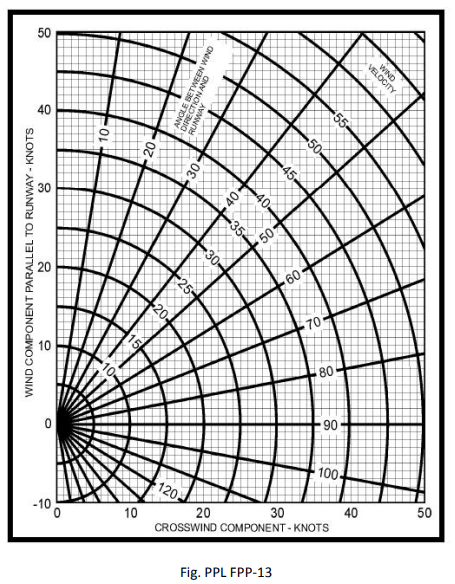
                                                                                                                                                                                                                                                                                          • What is the headwind component for a landing on Runway 18 if the tower reports the wind as 220°/30 kts? (See fig. PPL FPP-13e)

                                                                                                                                                                                                                                                                                            • What is the crosswind component for a landing on Runway 18 if the tower reports the wind as 220°/30 kts? (See fig. PPL FPP-13e)

                                                                                                                                                                                                                                                                                              • Which runway (06, 14, 24, 32) will you choose for landing, if tower reports south wind 20 kts and if maximum allowed crosswind component for your aircraft is 13 kts? (See fig. PPL FPP-13e)

                                                                                                                                                                                                                                                                                                • With the reported wind of 360°/20 kts you are approaching an airport. Which runway (06,14 or 24) would you choose for landing, if your airplane had a 13-knots maximum allowed crosswind component on landing? (See fig. PPL FPP-13e)

                                                                                                                                                                                                                                                                                                  • What are the headwind and crosswind components with the reported wind of 280°/15 kts for a runway with the magnetic direction 220°? (See fig. PPL FPP-13e)

                                                                                                                                                                                                                                                                                                    • Determine the maximum wind velocity for a 45° crosswind if the maximum crosswind component for the airplane is 25 kts? (See fig. PPL FPP-13e)

                                                                                                                                                                                                                                                                                                      • Determine the maximum wind velocity for a 40° crosswind if the maximum crosswind component for the airplane is 10 kts? (See fig. PPL FPP-13e)

                                                                                                                                                                                                                                                                                                        • Determine the maximum wind velocity for a 30° crosswind if the maximum crosswind component for the airplane is 10 kts? (See fig. PPL FPP-13e)

                                                                                                                                                                                                                                                                                                          • What are the headwind and crosswind components with the reported wind of 030°/10 kts for a runway with the magnetic direction 330°? (See fig. PPL FPP-13e)

                                                                                                                                                                                                                                                                                                            • What are the headwind and crosswind components with the reported wind of 130°/20 kts for a runway with the magnetic direction 040°? (See fig. PPL FPP-13e)
                                                                                                                                                                                                                                                                                                              • flight-planning-and-monitoring-1.png
                                                                                                                                                                                                                                                                                                              • flight-planning-and-monitoring-2.png
                                                                                                                                                                                                                                                                                                              • flight-planning-and-monitoring-3.png
                                                                                                                                                                                                                                                                                                              • flight-planning-and-monitoring-4.png
                                                                                                                                                                                                                                                                                                              • flight-planning-and-monitoring-5.png
                                                                                                                                                                                                                                                                                                              • flight-planning-and-monitoring-6.png
                                                                                                                                                                                                                                                                                                              • flight-planning-and-monitoring-7.png
                                                                                                                                                                                                                                                                                                              • flight-planning-and-monitoring-8.png
                                                                                                                                                                                                                                                                                                              • flight-planning-and-monitoring-9.png
                                                                                                                                                                                                                                                                                                              • flight-planning-and-monitoring-10.png